
 By khizar seo
As enterprise networks evolve, many organizations face a familiar challenge: how to modernize infrastructure without completely replacing what already works. While high-speed fiber deployments and multi-gig upgrades continue to gain traction, a significant portion of enterprise environments still rely on legacy copper cabling and Gigabit Ethernet equipment. In this context, 1G-T SFP modules have emerged as a practical and cost-efficient solution for extending the life of existing networks.
The Reality of Legacy Infrastructure
In many office buildings, campuses, and industrial facilities, Cat5e and Cat6 cabling has been in place for years. Replacing this cabling with fiber is not only expensive but also disruptive, often requiring downtime, reinstallation work, and coordination across multiple departments. For organizations running critical services, such disruptions are rarely acceptable.
At the same time, newer switches and network devices are increasingly designed with SFP ports rather than traditional RJ45 interfaces. This creates a compatibility gap between modern hardware and existing copper-based infrastructure.
Bridging the Gap with 1G-T SFP Modules
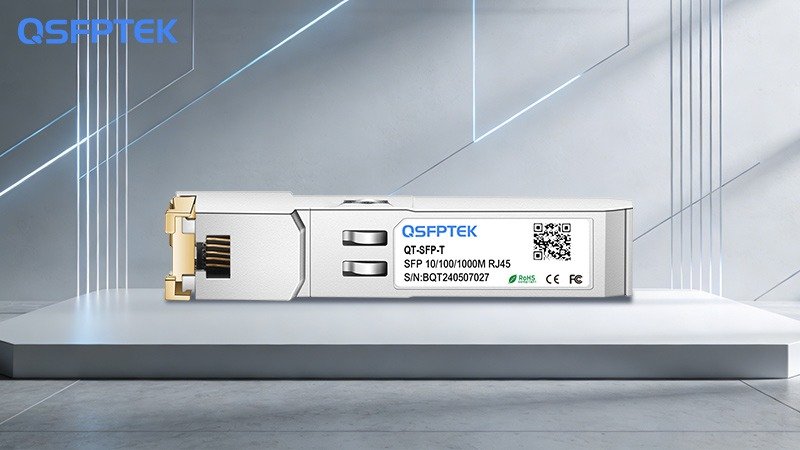
1G-T SFP modules provide a straightforward way to bridge this gap. By converting SFP ports into standard RJ45 Ethernet interfaces, they allow modern switches to connect directly to existing copper cabling. This eliminates the need for immediate large-scale rewiring while still enabling gradual network upgrades.
From a deployment perspective, these modules are plug-and-play. Network administrators can simply insert the module into an SFP port and connect a standard Ethernet cable, enabling seamless integration with legacy devices such as access switches, servers, and IP-based systems.
Reusing Copper Cabling for Cost Efficiency
One of the most compelling advantages of 1G-T modules is the ability to reuse existing cabling infrastructure. Copper cabling, especially Cat5e, is capable of supporting Gigabit speeds up to 100 meters, which is sufficient for most enterprise access layer connections.
By leveraging this installed base, organizations can significantly reduce capital expenditures. Instead of investing in new fiber runs, patch panels, and optical transceivers, they can extend network connectivity using components they already have in place. This approach is particularly valuable in large-scale enterprise upgrades, where cabling costs can quickly become the dominant expense.
Ideal for Enterprise Retrofit Projects
Enterprise network upgrades rarely happen all at once. More often, they are phased projects, where newer equipment is introduced alongside legacy systems. In such mixed environments, flexibility becomes essential.
1G-T SFP modules are well-suited for these retrofit scenarios. They allow IT teams to deploy new aggregation or core switches with SFP-based designs while maintaining connectivity to older access-layer devices. This ensures business continuity while gradually transitioning to more advanced architectures.
They are also commonly used in environments such as government facilities, hospitals, and educational institutions, where infrastructure lifecycles are long and budget constraints require incremental upgrades rather than full replacements.
Practical Considerations
While 1G-T modules offer clear benefits, there are some considerations to keep in mind. Compared to optical SFP modules, they typically consume more power and generate more heat due to the nature of electrical signaling. In high-density switch deployments, this can impact thermal design and port availability.
However, for most enterprise access applications, these trade-offs are manageable and are often outweighed by the cost savings and deployment simplicity they provide.
Conclusion
1G-T SFP modules play a crucial role in bridging legacy and modern network environments. By enabling copper cabling reuse and supporting incremental upgrades, they offer a balanced approach to network evolution. For organizations looking to extend the lifespan of their infrastructure while preparing for future technologies, 1G-T modules remain a highly practical and effective solution.